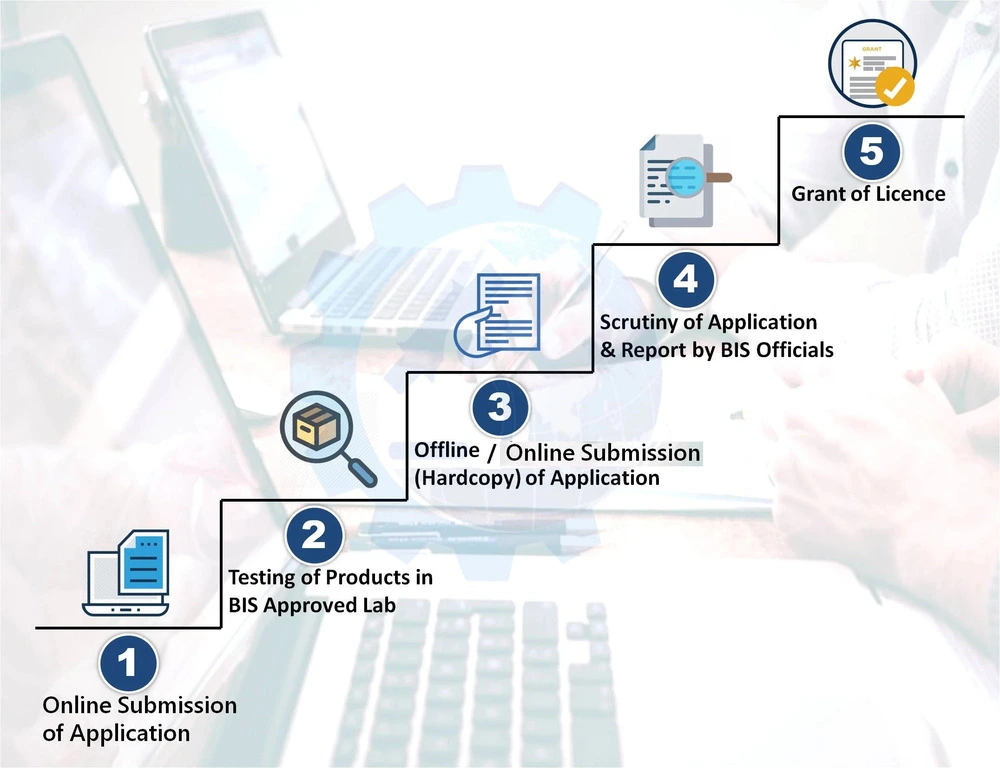
BIS Registration is getting a license from the Bureau of Indian Standards (BIS) for any product that conforms with the applicable Indian Standards. The Bureau of Indian Standards is the National Standards Body of India established under the Bureau of Indian Standards Act, 2016, under the Indian Ministry of Consumer Affairs, Food & Public Distribution, Government of India. The BIS is involved in various activities like Standards Formulation, Product Certification, Testing, Training Services, Hallmarking, Laboratory Services, Calibration Schemes, etc. The BIS registration acts as a third-party assurance of product quality, safety, and reliability.
The Bureau of Indian Standards grants licenses to the manufacturers for their products listed in BIS's mandatory or voluntary certification schemes. A manufacturer can display the standard mark on their product after obtaining a license from BIS. Although obtaining a BIS license is voluntary, the Indian government has made certain products mandatory to protect the environment, public health, national security, and the welfare of people, animals, and plants. It also aims to prevent unfair trade practices.
"Meet BIS standards, the mark of trust; Manufacture with precision, products robust;
Market expansion, with certification in hand;
Mastery over compliance, in the Indian market you'll stand;
And growth and prosperity will be your brand."
BIS Registration, or significant quality control compliance, is necessary when discussing electronic and IT products. This page will give you complete knowledge about BIS Registration under the Compulsory Registration Scheme (CRS) on this page. Let's examine the nature, organs, and history of the BIS License to understand the necessity of BIS registration certification.
Let's understand the BIS Registration for Electronics and IT Products.